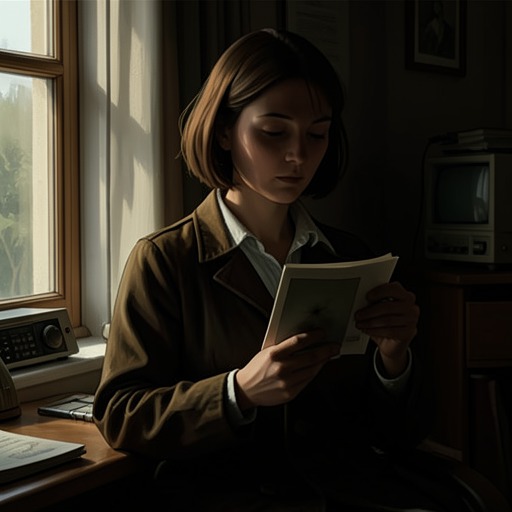
“Pale Ink”
Just One Look“Pale Ink,” the Jimmy X Band’s best-selling single of the year, becomes more than a hit: its words about memory and writing echo through Grace Lawson’s recurring dream of the Boston Garden disaster, while a later plagiarism dispute ties the song to the band’s backstage history and collapse. The story gives the song unusual double force—as familiar popular music that remains on the radio, and as a clue whose meaning depends on memories, accusations, and an old recording.
Identity and Form
The song is credited to the Jimmy X Band and written by James Xavier Farmington. Its opening lines ask for a best memory and then set that memory against pale ink, adapting a Chinese proverb for lyrics. That contrast gives the title a precise place in the novel’s concerns: memory may be vivid or emotionally powerful, yet it can be fragile, altered, and difficult to preserve. The song does not offer a settled explanation of the past; instead, it supplies language through which characters try to describe what memory can and cannot hold.
Its reach is established through more than a single recollection. The song was the year’s best-selling single, and characters later remark that radio still plays it. Captain Stuart Perlmutter remembers the Jimmy X Band as a group that mattered to him, and calls the song one of the best ever. Its continued circulation makes the past audible in ordinary life: the track outlasts the band that made it famous, while its associations remain unsettled.
A Hit Reappearing in Memory
For Grace Lawson, “Pale Ink” is bound to the Boston Garden catastrophe through a recurring dream. The dream places her at the old venue in front of the stage, leaning against a short steel blockade. The song plays over a loudspeaker before the concert has begun, an impossibility Grace recognizes even within the dream: it should be performed live, not played as waiting-time music. In the dream’s cinematic logic, however, the song becomes the soundtrack to the approaching tragedy.
The dream’s repeated beginning and ending, with variations in the middle, makes the song part of a loop rather than a simple recollection. Grace knows that disaster is about to strike but does not warn anyone or escape. The dream compresses the approach of catastrophe into seconds, whereas witnesses said that in reality she and the others had stood before the stage for more than four hours. “Pale Ink” thus accompanies not a reliable replay of events but Grace’s recurrent, constrained encounter with them: foreknowledge does not give her control.
The song also belongs to memories outside Grace’s. Captain Stuart Perlmutter recalls Marion Perlmutter listening to it on an old Walkman, eyes closed and lips moving as she silently sang along. The small, private image is distinct from its public success, but it reinforces the track’s persistence as something people carry with them. For Perlmutter, the song’s continuing radio life and Marion’s remembered listening coexist with the fact that the Boston Garden massacre destroyed the band and Jimmy X quit.
The Backstage Accusation
Years earlier, the song had become the center of a confrontation backstage. Jimmy X recalled that John Lawson appeared unexpectedly, initially seeming pleased to see him, then began pushing him and calling him a thief. Jimmy said Lawson accused him of stealing “Pale Ink.” According to Jimmy, the charge concerned a song Lawson and Shane Alworth had written for Allaw called “Invisible Ink.” He described the resemblance as limited: both titles shared the word ink, and both songs touched on the fragility of memory, but he denied that this made one a copy of the other.
Jimmy’s account also places the allegation in a violent encounter, not a calm discussion of authorship. He said Lawson seemed out of control, continued pushing him, and punched him after Jimmy tried to explain the difference. A dark-haired woman, as Jimmy remembered it, encouraged Lawson and joined in threatening him. The confrontation ended amid the wider melee; Jimmy referred to reports that he had been injured. These details are Jimmy’s retrospective account, and the evidence preserves the accusation and his denial without treating either as an uncontested finding.
The dispute takes on further significance when Grace later connects it to Jimmy’s sense of responsibility and his departure from public life. She accuses him of having taken the song after hearing Allaw perform in Manchester, and argues that this theft began the chain of events and helps explain why he ran away. Jimmy shakes his head and rejects her interpretation. The distinction matters: Grace’s accusation is a conclusion she reaches, while the song’s actual relationship to “Invisible Ink” remains to be tested against the recording.
The Recording and the Unresolved Boundary
That test comes when Grace receives a battered cassette with ALLAW faintly written on it in black ink. She plays it in the den, where “Invisible Ink” is the third track. Listening, she hears similarities to “Pale Ink,” but does not treat resemblance as proof of plagiarism. She considers whether a court would have found Jimmy guilty and concludes that the answer, after so many years, was probably no. In her judgment it would have been a close call: plenty of songs sound alike, and the boundary between influence and plagiarism can be difficult to draw.
The cassette therefore sharpens rather than resolves the mystery. It gives Grace an older musical object to compare with the famous hit, but it does not turn the accusation into certainty. Her final formulation—that so much that went wrong straddled a blurry line—links the copyright question to the novel’s broader pattern of uncertain memories, contested responsibility, and consequences that cannot be neatly assigned. “Pale Ink” endures as both a song people remember and a disputed trace of what may have happened before its success.